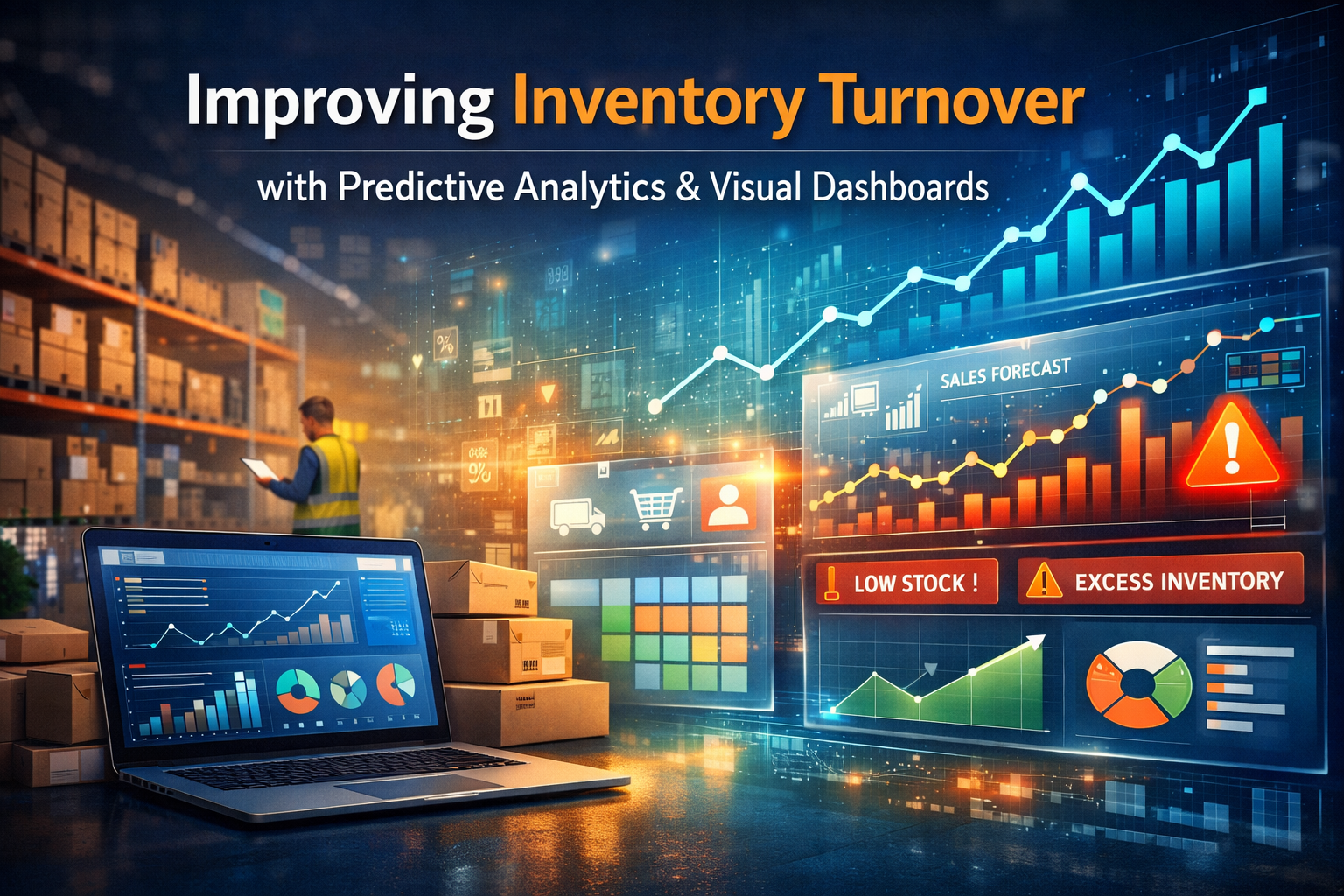
For retail and eCommerce businesses, inventory is one of the most powerful levers influencing profitability, cash flow, and customer experience. Every unit of inventory sitting unsold represents locked working capital. Every stockout during a peak sales period translates directly into lost revenue and dissatisfied customers. Yet, despite its importance, inventory decision-making in many organisations is still driven by historical reports, static forecasts, and instinct.
The modern retail environment has fundamentally changed. Demand patterns are no longer stable or predictable. Promotions create sharp spikes and sudden drop offs. Online traffic surges can occur without warning. Product lifecycles are shorter, assortments are wider, and customers expect seamless availability across channels. In this context, inventory turnover has evolved from a simple operational metric into a strategic indicator of how well demand, supply, and merchandising are aligned.
What separates high performing retail and eCommerce organisations today is not tighter control over inventory, but better foresight and better visibility. Predictive analytics enables retailers to anticipate demand, identify risk early, and make informed trade-offs before problems materialise. Visual dashboards ensure those insights are understood and acted upon across merchandising, supply chain, and leadership teams.
Drawing from retail analytics initiatives observed across the industry, including work supported by Techno Consultancy, this blog examines the real inventory turnover challenges retailers face and explains how predictive analytics and visual dashboards together provide a practical, scalable solution.
Inventory Turnover Challenges in Retail and eCommerce
Improving inventory turnover is rarely about fixing a single issue. It is the result of multiple, interconnected challenges that compound over time. Retailers often experience these challenges simultaneously, making traditional planning approaches increasingly ineffective.
1. Demand Volatility and Unpredictable Buying Behaviour
Retail and eCommerce demand has become highly volatile. Seasonal peaks, festive periods, flash sales, influencer driven campaigns, and marketplace promotions can all create sudden surges in demand. Equally, demand can drop sharply once a campaign ends or consumer sentiment shifts.
Traditional forecasting methods struggle in this environment. They rely heavily on historical averages and fixed assumptions, which fail to capture sudden behavioural changes. As a result, inventory plans are often misaligned with actual demand, leading either to excess stock or missed sales opportunities.
For omnichannel retailers, this volatility is amplified. The same product may perform differently across online and offline channels, regions, or fulfilment models, making uniform forecasting ineffective.
2. Overstocking, Stockouts, and Capital Lock In
Retail inventory planning is a constant balancing act. Overstocking leads to increased holding costs, markdown pressure, and eventual write offs. Stockouts, on the other hand, result in lost sales, reduced customer trust, and lower lifetime value.
To avoid stockouts, many retailers overcompensate by carrying excess buffer stock. While this may protect availability in the short term, it negatively impacts inventory turnover and ties up capital that could be invested elsewhere. Over time, this conservative approach erodes margins and operational agility.
Without accurate forward-looking insight, retailers are forced to choose between risk and inefficiency.
3. Slow Moving and Ageing Inventory Risks
Slow moving inventory is one of the biggest hidden drains on retail profitability. Products rarely become dead stock overnight. More often, they show early signs of declining demand that go unnoticed until inventory has already aged significantly.
Late detection limits options. Retailers are forced into aggressive discounting, bundle offers, or clearance sales that erode margin and brand perception. In categories such as fashion, electronics, and FMCG, ageing inventory can quickly become obsolete.
The challenge is not identifying slow movers after the fact, but recognising them early enough to intervene strategically.
4. Omnichannel Inventory Complexity
Most retail and eCommerce organisations now operate across multiple channels. Inventory may be held in central warehouses, regional distribution centres, stores, or even third-party fulfilment partners. Demand varies not just by product, but by channel and geography.
This creates imbalance. Some locations experience excess stock while others face shortages. Transfers and reallocations are often reactive, increasing operational cost and reducing responsiveness.
Siloed systems further complicate the picture. When POS data, eCommerce platforms, ERP systems, and marketplace feeds are not well integrated, inventory visibility becomes fragmented, making turnover optimisation extremely difficult.
5. Limitations of Traditional Inventory Reporting
Most retailers already track inventory metrics such as turnover ratio, days of inventory on hand, and sell through. However, these metrics are typically reviewed weekly or monthly, long after decisions have been made.
Traditional reports are backward looking. They explain what went wrong but rarely prevent it from happening again. Spreadsheet based analysis makes it difficult to spot patterns, prioritise actions, or simulate outcomes.
In fast moving retail environments, delayed insight is often as ineffective as no insight at all.
These challenges are not caused by lack of effort or discipline. They stem from a lack of foresight. This is where predictive analytics fundamentally changes how inventory decisions are made.
Solving Inventory Turnover Challenges with Predictive Analytics and Visual Dashboards
Predictive analytics and visual dashboards address inventory turnover challenges by shifting retail decision making from reactive to proactive. Together, they provide the foresight and clarity needed to manage complexity at scale.
1. How Predictive Analytics Improves Retail Demand Forecasting
Predictive analytics moves beyond static forecasts by continuously analysing patterns in historical sales, seasonality, promotions, channel behaviour, and external signals. Instead of producing a single forecast, it generates dynamic predictions that adapt as conditions change.
For retail and eCommerce teams, this means more accurate SKU level forecasts by channel and region. Demand can be anticipated not just for upcoming seasons, but for specific campaigns, launches, or clearance events.
Predictive models learn from previous outcomes, improving forecast accuracy over time. This allows planners to respond earlier and with greater confidence.
2. Early Detection of Excess and At-Risk Inventory
One of the most valuable contributions of predictive analytics is early risk identification. By comparing projected demand against current and incoming stock, analytics models can flag products likely to become excess inventory.
This early warning enables proactive decisions. Retailers can adjust replenishment plans, reallocate stock across locations, or include products in targeted promotions before inventory ages.
Early intervention preserves margin, improves turnover, and reduces reliance on deep discounting.
3. Smarter Replenishment and Safety Stock Decisions
Predictive analytics also improves replenishment planning. Rather than relying on fixed reorder points and uniform safety stock levels, models account for demand variability and lead time uncertainty.
High velocity SKUs during peak periods can be replenished aggressively, while slower moving items are controlled more tightly. Safety stock is optimised based on service level targets rather than conservative assumptions.
This precision helps retailers improve inventory turnover without increasing stockout risk, a balance that is difficult to achieve with traditional planning methods.
4. Visual Dashboards as the Action Layer for Retail Teams
Analytics alone does not improve outcomes unless insights are acted upon. Visual dashboards translate complex predictive models into intuitive, decision ready views.
Dashboards combine current inventory positions with future demand projections, allowing teams to see not just where inventory stands today, but where it is heading. Risk indicators highlight products likely to stock out or become excess.
By reducing cognitive load, dashboards enable faster, more confident decisions across teams.
5. Role Based Dashboards for Retail Stakeholders
Inventory decisions involve multiple stakeholders. Merchandising teams focus on category performance and sell through. Supply chain teams manage replenishment and fulfilment risk. Leadership teams track working capital and margin impact.
Role based dashboards ensure each stakeholder sees relevant insights without being overwhelmed. This alignment prevents siloed decision making and ensures coordinated action across the organisation.
6. Embedding Predictive Insights into Daily Retail Operations
Dashboards deliver the greatest value when embedded into regular planning routines. High performing retailers use dashboards in demand planning meetings, replenishment reviews, and campaign planning sessions.
Alerts notify teams when predictive indicators cross thresholds, prompting timely intervention. Inventory management shifts from periodic review to continuous optimisation.
Conclusion
Improving inventory turnover in retail and eCommerce is no longer about tightening controls or reacting faster after issues arise. It is about anticipating demand, identifying risk early, and enabling teams to act with clarity.
Predictive analytics provides foresight. Visual dashboards provide visibility. Together, they transform inventory management into a strategic capability that improves cash flow, protects margin, and enhances customer experience.
Based on applied retail analytics work across the industry, including initiatives supported by Techno Consultancy, organisations that embed predictive insight and visual clarity into inventory decision making consistently outperform those relying on historical reporting alone.
As retail and eCommerce environments continue to evolve, the ability to improve inventory turnover through predictive analytics and dashboards will increasingly define competitive advantage.
Ready to Transform Your Business?
Partner with Techno Consultancy to implement advanced solutions tailored to your organization's unique needs.
Get in Touch