Education has always evolved alongside technology. From blackboards to projectors, from computer labs to learning management systems, every shift has aimed to improve access, consistency, and quality of learning. Yet, despite all these advances, one fundamental challenge remains unresolved. Teaching does not scale easily.
Faculty members are expected to support increasingly diverse student populations, deliver personalized guidance, manage assessments, and stay current with evolving curricula. At the same time, students expect instant support, flexible learning, and explanations tailored to their pace and understanding. Traditional digital tools help distribute content, but they do not actively participate in the learning process.
This is where Generative AI changes the equation.
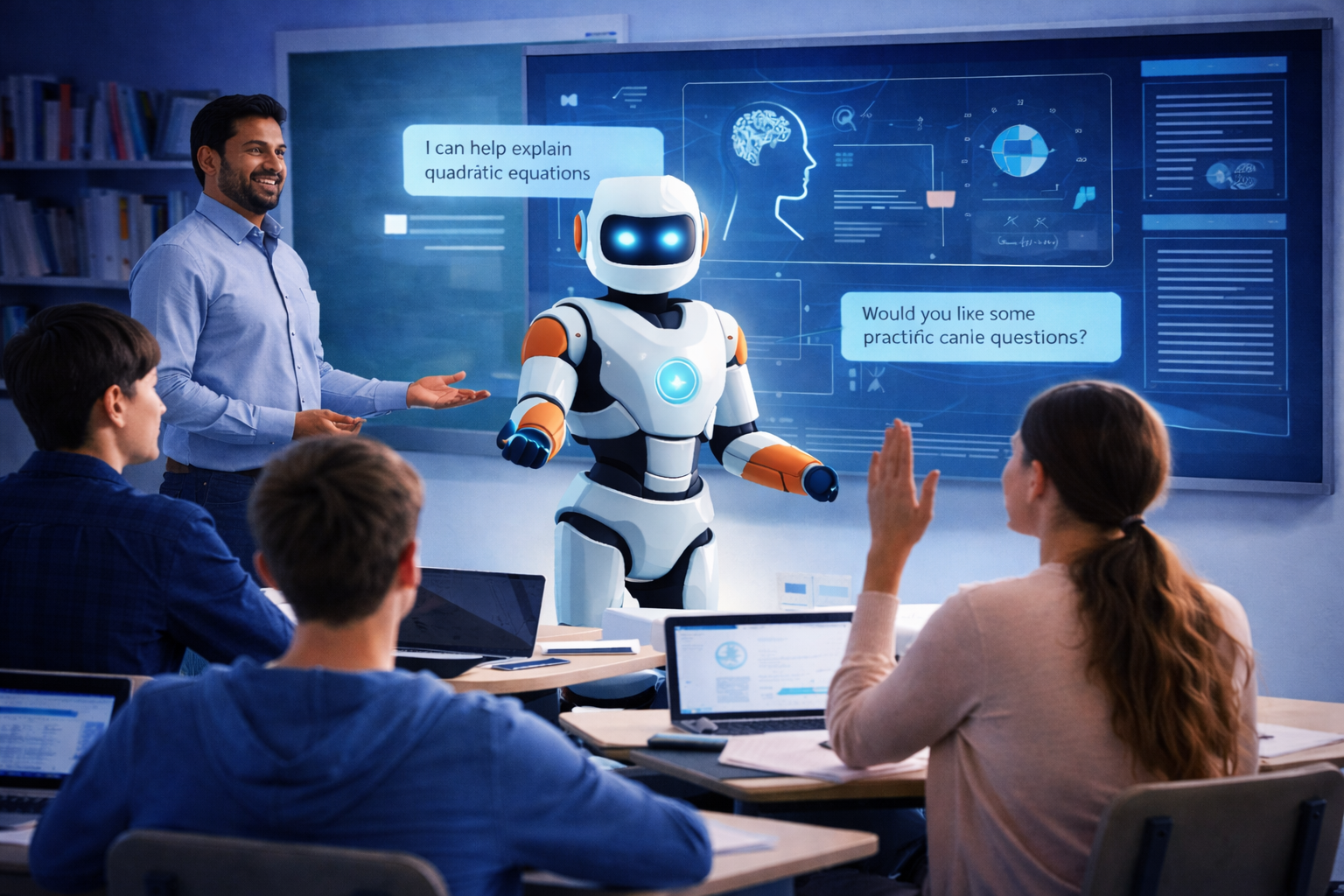
Generative AI knowledge assistants, when designed thoughtfully, can function as digital co-teachers. They do not replace educators or automate teaching. Instead, they support learning by answering questions, reinforcing concepts, guiding practice, and providing continuity outside the classroom.
Many institutions working with Techno Consultancy begin by recognizing a simple truth. The future of education is not human versus AI. It is human educators supported by intelligent systems that extend their reach and impact.
What Makes a Generative AI Knowledge Assistant a True Digital Co-Teacher
Not every AI system used in education deserves to be called a digital co-teacher. The difference lies not in the sophistication of the model, but in how the assistant participates in learning.
1. From Answering Questions to Supporting Understanding
Most students have already interacted with AI tools that provide instant answers. While convenient, these tools often create shallow learning. Students receive information, but not understanding.
A true AI co-teacher works differently. Its goal is not to answer questions quickly, but to help students learn effectively.
For example, when a student struggles with a concept in economics or physics, a digital co-teacher might:
- Explain the idea using simpler language
- Provide a real-world analogy
- Ask a follow-up question to check understanding
- Offer an alternative explanation if confusion persists
This mirrors how a good teacher supports learning in person.
2. Grounded in Curriculum, Not the Open Internet
One of the biggest risks of using generic AI tools in education is misalignment with curriculum. Public models are trained on vast, unfiltered data, which may conflict with institutional syllabi or academic standards.
A digital co-teacher must be deeply aligned with institutional content, including:
- Course objectives
- Lecture materials
- Prescribed textbooks
- Approved research and references
When students ask questions, the AI responds in a way that reinforces what is taught in class, not contradicts it. This alignment builds trust among both students and faculty.
3. Adapting to Learner Context
Students do not all learn the same way or at the same pace. Some need foundational explanations, while others seek deeper insights or applied examples.
A Generative AI co-teacher adapts by:
- Adjusting complexity based on learner level
- Offering step-by-step explanations when needed
- Providing summaries for revision
- Reinforcing prior concepts before introducing new ones
This adaptability allows institutions to deliver personalized learning at scale, something that is difficult to achieve through traditional teaching alone.
4. Supporting Educators, Not Competing With Them
One of the most common concerns around AI in education is the fear that it undermines the role of teachers. In practice, the opposite is true when AI is positioned correctly.
Digital co-teachers:
- Handle repetitive student queries
- Assist with practice material creation
- Support formative assessments
- Provide insights into common student difficulties
This frees educators to focus on higher-value activities such as mentoring, discussion-based learning, curriculum design, and research.
At Techno Consultancy, this balance between human expertise and AI assistance is treated as a design principle rather than an afterthought.
A Practical and Strategic Approach to Building AI Co-Teachers
Building a Generative AI knowledge assistant is not a technology experiment. It is an institutional capability that requires careful planning, governance, and long-term vision.
Step 1: Start With Clear Educational Intent
Every successful AI initiative in education starts with clarity, not technology. Before introducing a digital co-teacher, institutions must clearly define what academic challenge the AI is meant to address.
A useful way to think about this is to ask: “What learning or teaching problem will be easier once this AI system is in place?”
Common and practical starting points include:
- Supporting students outside classroom hours: Students often study late at night, before exams, or between lectures. A digital co-teacher can provide academic help during these times, ensuring learning continues even when faculty are unavailable.
- Reducing repetitive faculty effort: Educators frequently answer the same questions across emails, discussion boards, and classes. AI can handle these recurring queries, allowing faculty to focus on deeper teaching and mentoring.
- Ensuring consistent explanations: In institutions with multiple sections or campuses, students may receive different explanations for the same topic. A digital co-teacher helps maintain consistency by reinforcing institution-approved explanations.
- Supporting students who need additional help: Some learners need refresher content or extra practice before progressing. AI can guide them through prerequisite concepts at their own pace.
By defining these goals early, institutions avoid deploying AI that appears advanced but does not meaningfully improve learning or teaching outcomes.
Step 2: Build a Reliable Academic Knowledge Base
AI systems rely entirely on the information they are given. If academic content is scattered, outdated, or unclear, the AI’s responses will be unreliable.
Before deploying a digital co-teacher, institutions must organize and validate their academic material.
This usually involves:
- Bringing academic content into one place: Lecture notes, presentations, reading materials, and reference documents should be stored centrally rather than across multiple platforms or personal folders.
- Removing outdated or duplicate material: Old content can confuse both students and AI systems. Cleaning this up ensures responses reflect current teaching.
- Deciding who owns and approves content: Faculty ownership ensures academic accountability. Only approved material should be used by the AI.
- Keeping content aligned with curriculum changes: When syllabi or learning objectives change, the AI’s knowledge must be updated accordingly.
This step forms the foundation of trust. Institutions often underestimate it, but it largely determines whether students and faculty will rely on the AI system.
Step 3: Ensure AI Answers Are Based on Approved Academic Content
One concern with AI systems is that they may produce confident but incorrect answers. In education, this risk must be carefully managed.
To address this, institutions can design AI systems so that they first look up relevant academic material before responding to a student question. This ensures answers are based on approved content rather than general assumptions.
In simple terms, the AI finds the most relevant institutional material and uses that material to frame its explanation. This approach provides several benefits:
- More accurate and reliable responses
- Clear alignment with institutional teaching
- Greater confidence among faculty
- Better support for academic quality standards
This design choice helps ensure the AI reinforces learning rather than introducing confusion.
Step 4: Set Clear Academic and Ethical Boundaries
Education requires strong safeguards. A digital co-teacher must follow the same academic values as human educators.
Important boundaries include:
- Avoiding direct answers to exams and graded assignments: The AI should support learning by explaining concepts, outlining approaches, and guiding critical thinking, rather than completing assessed work for students.
- Promoting understanding over shortcuts: Responses should emphasize reasoning, examples, and step-by-step explanations that help students learn, instead of providing final answers that bypass the learning process.
- Safeguarding student data and interactions: All student queries and interactions must be handled securely, with strict confidentiality and appropriate access controls to protect personal and academic information.
- Ensuring compliance with institutional and regulatory standards: AI usage should align with academic policies, accreditation requirements, and applicable data protection regulations, ensuring responsible and compliant deployment.
When these boundaries are built into the system from the start, faculty trust increases and misuse decreases.
Step 5: Fit AI Into Existing Academic Systems
AI adoption fails when students or faculty have to learn entirely new systems. A digital co-teacher should feel like a natural extension of existing academic platforms.
This means integrating AI into tools already used daily, such as:
- Learning management systems
- Student portals
- Digital libraries
- Collaboration and discussion platforms
When AI support appears in familiar environments, usage becomes intuitive. Students are more likely to ask questions, and faculty are more comfortable recommending the system.
Step 6: Treat the Digital Co-Teacher as an Ongoing Academic Resource
A digital co-teacher is not something an institution deploys once and forgets. Education evolves, and the AI must evolve with it.
Continuous improvement typically includes:
- Structured faculty feedback loops: Educators play a critical role in refining the AI’s academic behaviour. Their feedback helps improve explanation quality, correct inaccuracies, and ensure responses remain aligned with teaching intent and curriculum standards.
- Analysis of student questions and interaction patterns: Repeated or similar student queries often reveal concepts that require clearer explanations or additional learning support. These insights help institutions strengthen both AI responses and underlying academic content.
- Measurement of learning impact: Institutions should regularly evaluate whether the AI co-teacher is positively influencing student engagement, comprehension, and progression. This may include tracking usage patterns, learning reinforcement effectiveness, and reduction in unresolved student queries.
- Ongoing content and curriculum alignment: As syllabi, learning objectives, and assessment approaches evolve, the AI’s knowledge base must be updated to reflect these changes. Regular content reviews ensure the system continues to deliver accurate, relevant, and institution-approved guidance.
By embedding these practices into academic operations, institutions ensure their digital co-teacher remains relevant, trusted, and genuinely supportive of learning outcomes over the long term. Institutions that treat AI as a long-term academic resource rather than a one-time project see far greater value over time.
Techno Consultancy typically supports institutions throughout this journey, helping align academic goals with practical, responsible AI implementation.
Conclusion
Generative AI knowledge assistants are reshaping how education is delivered and supported. When positioned as digital co-teachers, they enhance learning without diluting academic integrity or the role of educators.
The institutions that will lead in the coming decade are not those that adopt AI hastily, but those that adopt it responsibly, thoughtfully, and strategically. By grounding AI in curriculum, pedagogy, and governance, educational institutions can create learning environments that are more inclusive, adaptive, and resilient.
The future of education is not automated teaching. It is collaborative intelligence, where human educators and AI co-teachers work together to support every learner more effectively.
For institutions beginning or refining their Generative AI journey, working with experienced digital transformation partners like Techno Consultancy helps turn ambition into sustainable academic impact.
Ready to Transform Your Business?
Partner with Techno Consultancy to implement advanced solutions tailored to your organization's unique needs.
Get in Touch