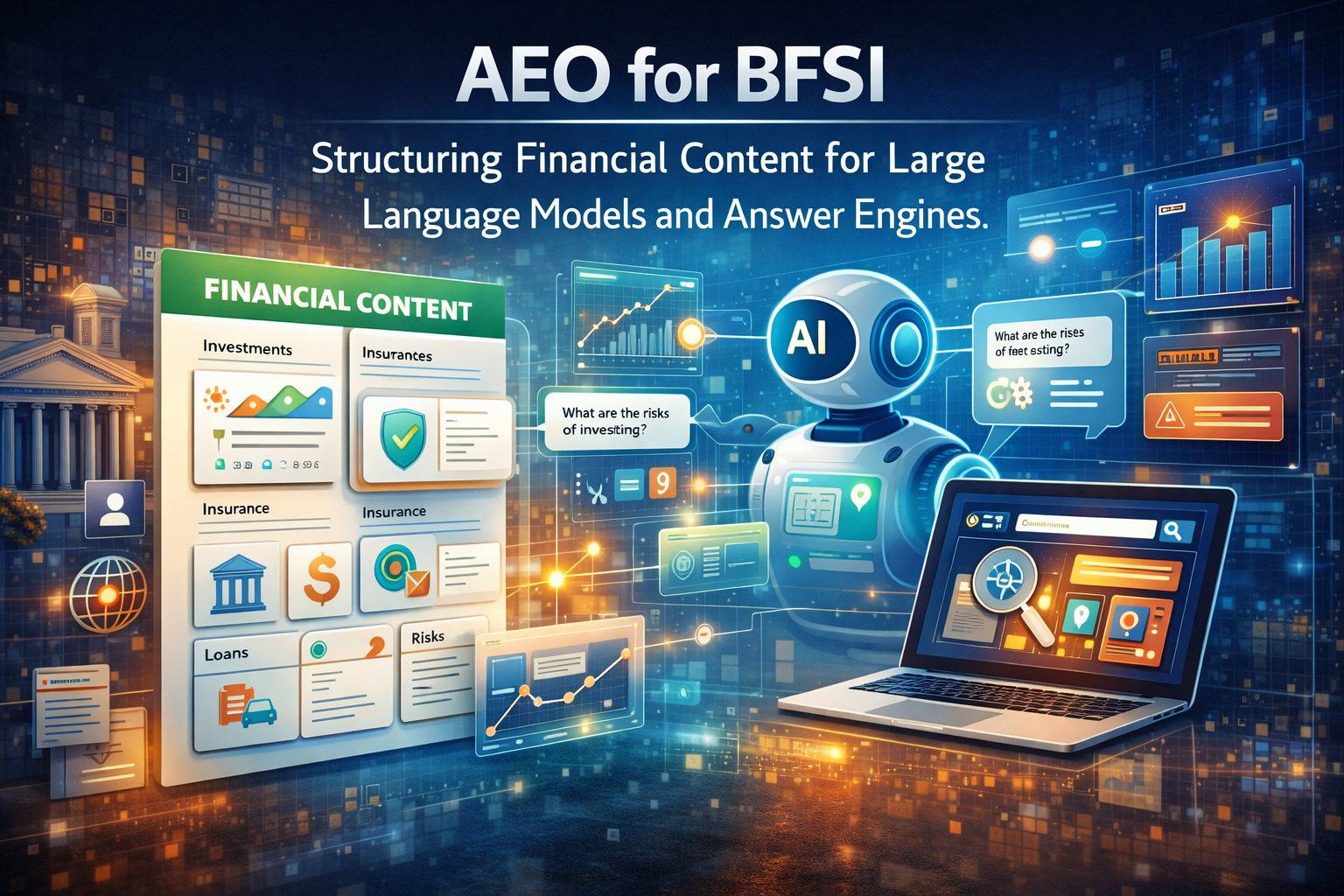
When customers search for information about loans, insurance policies, investments, or financial regulations today, they are increasingly presented with direct answers, not lists of links. These answers come from AI powered search experiences and large language models that summarise and generate responses on the user's behalf.
For BFSI organisations, this changes what visibility means.
Visibility is no longer only about ranking on a search results page. It is about whether an AI system is confident enough to select your content, interpret it correctly, and surface it as an answer. If your content is not selected, it is effectively invisible, even if it ranks well in traditional search.
This shift is especially important for financial services. BFSI content sits in a high-trust and high-risk category. Answer engines are cautious about what they surface. They prioritise content that is clear, structured, and reliable enough to be reused without introducing error.
Across BFSI digital content initiatives observed by Techno Consultancy, one pattern is consistent. Organisations that understand how large language models interpret financial content significantly improve their presence and visibility in AI generated answers, not by optimising harder, but by writing smarter.
This blog explains how large language models process financial information, and how BFSI organisations can structure content to increase the likelihood of being selected and surfaced by answer engines, while remaining accurate and compliant.
How Large Language Models Interpret Financial Content and Decide What to Surface
Large language models do not browse websites the way humans do. They do not evaluate brand reputation or marketing intent. Instead, they process text by identifying patterns, relationships, and signals of reliability.
Understanding this behaviour is critical, because it directly influences which BFSI content becomes visible in AI generated answers.
Meaning Is Inferred, Not Verified
Large language models do not verify facts in real time. They infer meaning based on how consistently and clearly information is presented across sources. When multiple explanations exist for the same financial concept, models gravitate toward the ones that are least ambiguous.
For BFSI content, this has a direct visibility impact. Content that blends explanations, softens definitions, or relies on implied meaning is harder for models to reuse. As a result, it is less likely to be selected when an answer engine generates a response.
Clear, explicit explanations increase the probability that your content is surfaced accurately.
Why Financial Content Faces Higher Selection Thresholds
Financial services content falls under Your Money Your Life categories. Because incorrect answers can cause real world harm, answer engines apply stricter confidence and safety heuristics before surfacing responses.
This means BFSI content competes on trustworthiness as much as relevance. Pages that read like educational guides tend to be surfaced more often than pages that read like promotional material.
From a visibility perspective, this explains why some BFSI brands struggle to appear in AI answers despite strong SEO performance. Their content is discoverable, but not reusable.
Structure as a Visibility Signal
Structure plays a crucial role in how LLMs decide what to surface. Clear headings, focused sections, and well scoped explanations help models identify complete answers.
When financial content is tightly structured, models can extract and reuse it with greater confidence. When content is long, blended, or loosely organised, models are more likely to skip it in favour of clearer alternatives.
In practical terms, better structure directly increases answer inclusion.
Tone and Language Influence Selection
Large language models are sensitive to tone. Content that uses precise, neutral language aligned with formal financial communication is interpreted as more authoritative.
Marketing heavy language, vague claims, or conversational shortcuts introduce uncertainty. That uncertainty reduces the likelihood that the content will be selected for AI generated answers.
For BFSI organisations, visibility improves when content prioritises explanation over persuasion.
Why Ambiguity Reduces AI Visibility
Ambiguity is one of the biggest barriers to visibility in answer engines. A sentence that seems acceptable to a human reader can be risky for a model to reuse.
If a definition allows multiple interpretations, the model may avoid it altogether. Or worse, it may generate an oversimplified answer that strips away critical context.
From an AEO perspective, reducing ambiguity is not only about accuracy. It is about ensuring your content is safe for AI systems to surface.
How BFSI Organisations Should Write to Increase Visibility in Answer Engines
Once BFSI teams understand how LLMs interpret and select content, the next step is writing with visibility in mind. The goal is to make financial content easy for AI systems to select, reuse, and summarise accurately.
Write Financial Content as Clear Answer Units
Answer engines prefer content that can stand on its own. Each key concept should be explained fully within a defined boundary.
For example, what a product is, how it works, who it applies to, and what the risks are should be addressed clearly and separately. This allows AI systems to lift complete explanations without guessing.
Content written in this way has a much higher chance of being surfaced as a direct answer.
Use Question Led Structures to Match User Intent
Answer engines respond to questions. BFSI organisations already know what customers ask through search data, call centre logs, and advisory interactions.
Structuring content so that these questions are answered explicitly improves alignment with AI query matching. This does not mean turning every page into a list of FAQs, but ensuring that core questions are clearly resolved within the content.
Clear answers improve both accuracy and discoverability.
Balance Simplicity with Precision
Readable content performs better in AI environments, but only when precision is preserved. Oversimplifying financial concepts may improve short term engagement, but it reduces AI confidence.
Answer engines are more likely to surface content that explains conditions, limitations, and risks alongside benefits. This balance increases trust and visibility at the same time.
Make Context Explicit, Not Assumed
One of the most common problems in AI generated financial answers is loss of context. Geography, regulation, eligibility, and assumptions are often removed when content is summarised.
To counter this, BFSI content should embed context directly into explanations. When context is optional for humans, it becomes invisible to AI systems.
Explicit context improves safe reuse and increases answer inclusion.
Maintain Consistency Across All Financial Content
Large language models learn across multiple pages. If the same term is defined differently across your website, models attempt to reconcile those differences on their own.
This reduces confidence and can limit visibility. Consistent definitions, stable terminology, and aligned explanations across content types make it easier for AI systems to select your content reliably.
In this sense, AEO is as much a content governance discipline as it is a writing practice.
Implementation Reality for BFSI Content Teams
Improving visibility in answer engines does not require rewriting everything at once. Most BFSI organisations see results by starting with high impact informational content such as product explainers, financial education resources, and regulatory guides.
Content audits should focus on clarity, structure, and interpretability, not just keywords. Over time, teams can establish internal writing guidelines designed specifically for AI answer environments.
From BFSI programmes supported by Techno Consultancy, organisations that treat AEO as a visibility and trust initiative, rather than a traffic tactic, achieve stronger and more sustainable presence in AI driven discovery.
Conclusion
In answer first search environments, visibility is no longer about being found. It is about being chosen.
Large language models decide which BFSI content is safe, clear, and reliable enough to surface as answers. Organisations that understand this selection logic can significantly improve their presence in AI generated responses without compromising compliance or accuracy.
AEO for BFSI is not about chasing algorithms. It is about structuring financial knowledge so that AI systems can interpret and reuse it confidently.
Based on real world BFSI content initiatives, including those supported by Techno Consultancy, organisations that invest in clear structure, explicit context, and precise language consistently enhance their visibility in answer engines.
As AI continues to reshape how financial information is discovered, the BFSI brands that will remain visible are those that write not just to rank, but to be understood and trusted by the systems answering on their behalf.
Ready to Transform Your Business?
Partner with Techno Consultancy to implement advanced solutions tailored to your organization's unique needs.
Get in Touch