HR automation is often discussed as a matter of digitising forms, introducing workflows, or replacing spreadsheets with software. While these steps improve efficiency, they do not fully address the complexity modern HR teams face. Workforce structures are changing, compliance requirements are growing stricter, and employee expectations around experience and responsiveness are higher than ever.
Traditional workflow automation relies on predefined rules. It works well when processes are predictable and exceptions are rare. However, HR processes are rarely static. They involve human behaviour, interpretation of documents, contextual decision making, and frequent exceptions. This is where AI driven automation becomes materially different from basic digitisation.
Across organisations undergoing HR transformation, including those Techno Consultancy has worked with, a consistent shift is visible. HR leaders are no longer asking how to automate tasks. They are asking how to reduce interpretation effort, anticipate issues, and make HR operations more adaptive.
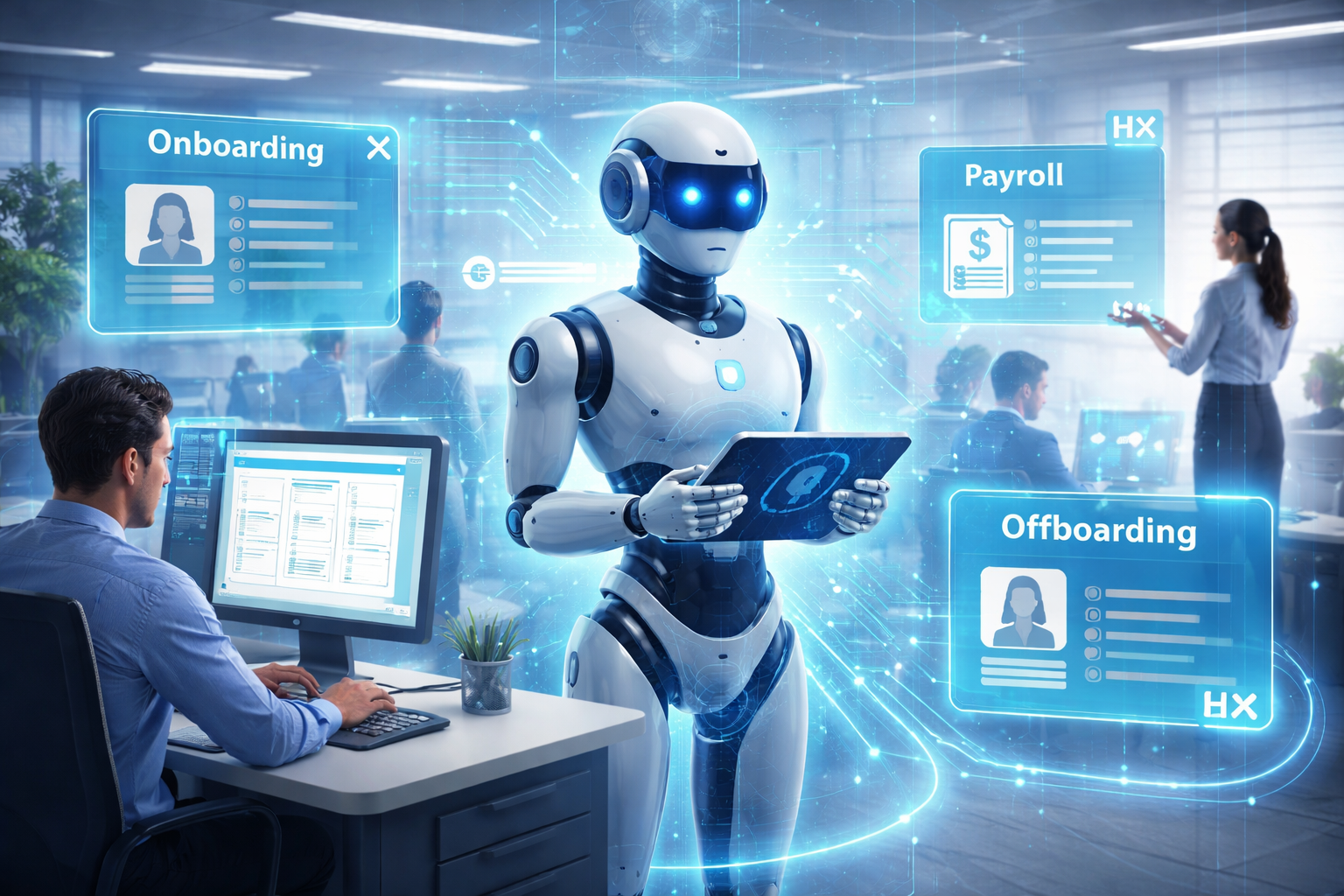
This blog explores how AI enabled HR automation transforms three of the most critical HR processes; onboarding, offboarding, and payroll. Rather than treating AI as an add on, we examine how intelligence is embedded into workflows to make HR operations more resilient, accurate, and scalable.
AI Driven Automation for Onboarding and Offboarding Across the Employee Lifecycle
Onboarding and offboarding are defining moments in the employee lifecycle. They directly affect productivity, security, compliance, and perception of the organisation. While many organisations have digitised these processes, fewer have made them intelligent.
AI introduces the ability to interpret, adapt, and detect patterns within these workflows, reducing manual effort and improving consistency.
Why Lifecycle Automation Needs AI, Not Just Workflows
Traditional onboarding and offboarding automation focuses on task orchestration. Emails are triggered, forms are assigned, and approvals are routed. While this reduces manual follow ups, it still assumes clean inputs and predictable scenarios.
In reality, HR teams spend a significant amount of time reviewing documents, validating information, answering repetitive questions, and handling exceptions. AI addresses these gaps by automating judgement heavy steps, not just task execution.
AI Enabled Onboarding
AI driven onboarding starts the moment an offer is accepted, but its value goes far beyond issuing documents.
Instead of HR manually reviewing identity proofs, contracts, and compliance forms, AI based document processing systems can extract, validate, and cross check information automatically. Missing fields, inconsistencies, or expired documents are flagged in real time, reducing onboarding delays.
Natural language models can also generate contextual onboarding communication. Rather than sending generic welcome emails, AI can personalise messages based on role, location, and seniority. Policy documents and handbooks can be summarised in plain language, improving comprehension and reducing back-and-forth queries.
AI also improves coordination across teams. By analysing role profiles and historical onboarding data, systems can anticipate required system access, training paths, and equipment needs. This reduces first week friction and accelerates time-to-productivity.
From an implementation perspective, organisations adopting AI assisted onboarding see the greatest impact when intelligence is applied to information interpretation and exception handling, not just document routing.
Implementing AI in Onboarding Workflows
Successful AI onboarding implementation requires careful alignment between HR, IT, and compliance teams. Clean data foundations are critical. AI models rely on consistent document formats, standardised role definitions, and clearly defined policies.
In practice, organisations often begin by introducing AI into specific onboarding stages, such as document verification or employee query handling, before expanding to predictive recommendations. This phased approach reduces risk and improves adoption.
Experience from HR transformation initiatives shows that AI delivers the most value when it reduces cognitive load on HR teams, allowing them to focus on employee engagement rather than validation tasks.
AI Enabled Offboarding
Offboarding is one of the most underestimated HR processes. While task-based automation ensures access is revoked and documents are issued, AI introduces proactive risk detection.
AI systems can analyse historical offboarding data to identify patterns associated with compliance gaps or security incidents. For example, delayed access revocation, incomplete knowledge transfer, or unresolved asset returns can be flagged automatically based on risk scoring.
Natural language processing can assist in analysing exit interviews or feedback, identifying themes related to attrition drivers or policy gaps. This transforms offboarding from a procedural activity into a source of organisational insight.
AI also improves coordination during exits. Instead of relying on static checklists, intelligent workflows adapt based on role sensitivity, system access levels, and regulatory requirements. High risk exits receive additional scrutiny without slowing down standard processes.
Designing an Intelligent Employee Lifecycle
The real value of AI emerges when onboarding and offboarding are designed as part of a continuous employee lifecycle system. Shared data models, unified workflows, and learning feedback loops allow the system to improve over time.
From practical implementation experience, organisations achieve the most sustainable outcomes when AI is embedded to support decision-making, not replace HR judgement. Automation handles scale and consistency, while humans retain control over sensitive decisions.
AI Powered Payroll Automation as a System of Trust, Accuracy, and Insight
Payroll is one of the most sensitive HR processes. Errors affect employee trust immediately and expose organisations to regulatory penalties. While payroll automation has existed for years, most systems remain heavily rule-based.
AI introduces a new dimension by enabling anomaly detection, predictive insights, and intelligent validation, significantly reducing payroll risk.
Why Traditional Payroll Automation Is No Longer Enough
Rule-based payroll systems depend on clean inputs. Attendance data, leave records, compensation changes, and statutory updates must be accurate for the system to work correctly. In reality, inconsistencies are common.
AI augments payroll automation by learning from historical payroll data. Instead of blindly applying rules, AI models identify deviations from normal patterns and flag them before payroll is processed. This includes unusual overtime, duplicate entries, unexpected deductions, or salary anomalies.
This shift changes payroll from a reactive process to a preventive one.
AI Capabilities in Modern Payroll Automation
One of the most impactful applications of AI in payroll is anomaly detection. Machine learning models analyse past payroll cycles to establish baseline patterns. When current payroll data deviates from these patterns, the system highlights potential issues for review.
AI also improves data validation. For example, if attendance records conflict with approved leave or if compensation changes do not align with policy norms, the system flags inconsistencies automatically.
Natural language interfaces further simplify payroll operations. HR and finance teams can query payroll data conversationally, reducing dependency on reports and spreadsheets. This improves accessibility and decision-making speed.
Predictive analytics adds another layer of value. AI can forecast payroll impact based on hiring plans, attrition trends, or policy changes, supporting better workforce cost planning.
Implementing AI Driven Payroll Automation
Payroll automation with AI must be implemented carefully. Data quality is critical. Organisations must standardise employee records, attendance data, and compensation structures before introducing intelligence.
Governance is equally important. AI systems should support payroll teams by highlighting risks, not making unilateral decisions. Approval workflows and audit trails remain essential to ensure accountability.
From implementation experience, including payroll modernisation initiatives Techno Consultancy has supported, AI delivers the highest value when positioned as a decision support layer rather than a fully autonomous system.
Integrating Payroll with AI Enabled HR Ecosystems
Payroll does not operate in isolation. Its effectiveness depends on accurate onboarding data and timely offboarding updates. AI enabled integration ensures that employee lifecycle changes are reflected in payroll calculations automatically.
When payroll, onboarding, and offboarding share a common intelligent data layer, organisations gain end-to-end visibility into workforce movement and cost implications. This integration reduces reconciliation effort and improves compliance confidence.
Strategic Value Beyond Salary Processing
AI powered payroll systems provide insights beyond payslip generation. Workforce cost trends, benefit utilisation, and overtime patterns become easier to analyse and act upon.
For leadership teams, this transforms payroll from an operational necessity into a strategic data asset. Decisions around hiring, compensation planning, and cost optimisation are supported by reliable, real-time insights.
Conclusion
HR automation has evolved beyond digitising tasks. The next phase is about embedding intelligence into HR processes so they can adapt, detect risk, and support better decision making.
AI driven onboarding and offboarding reduce manual interpretation, improve compliance, and enhance employee experience during critical transitions. AI powered payroll automation strengthens accuracy, builds trust, and provides predictive insight into workforce costs.
The organisations that succeed with HR automation are those that apply AI thoughtfully. Not everywhere, but where complexity, scale, and risk demand intelligence. Automation handles consistency and execution, while AI supports judgement and foresight.
Based on practical experience across HR transformation initiatives, including those supported by Techno Consultancy, the most effective HR systems are not the most automated, but the most intelligently designed. As workforce models continue to evolve, AI enabled HR automation will play a central role in building resilient, future ready organisations.
Ready to Transform Your Business?
Partner with Techno Consultancy to implement advanced solutions tailored to your organization's unique needs.
Get in Touch